AI Face Swap vs Deepfake: What’s the Difference?
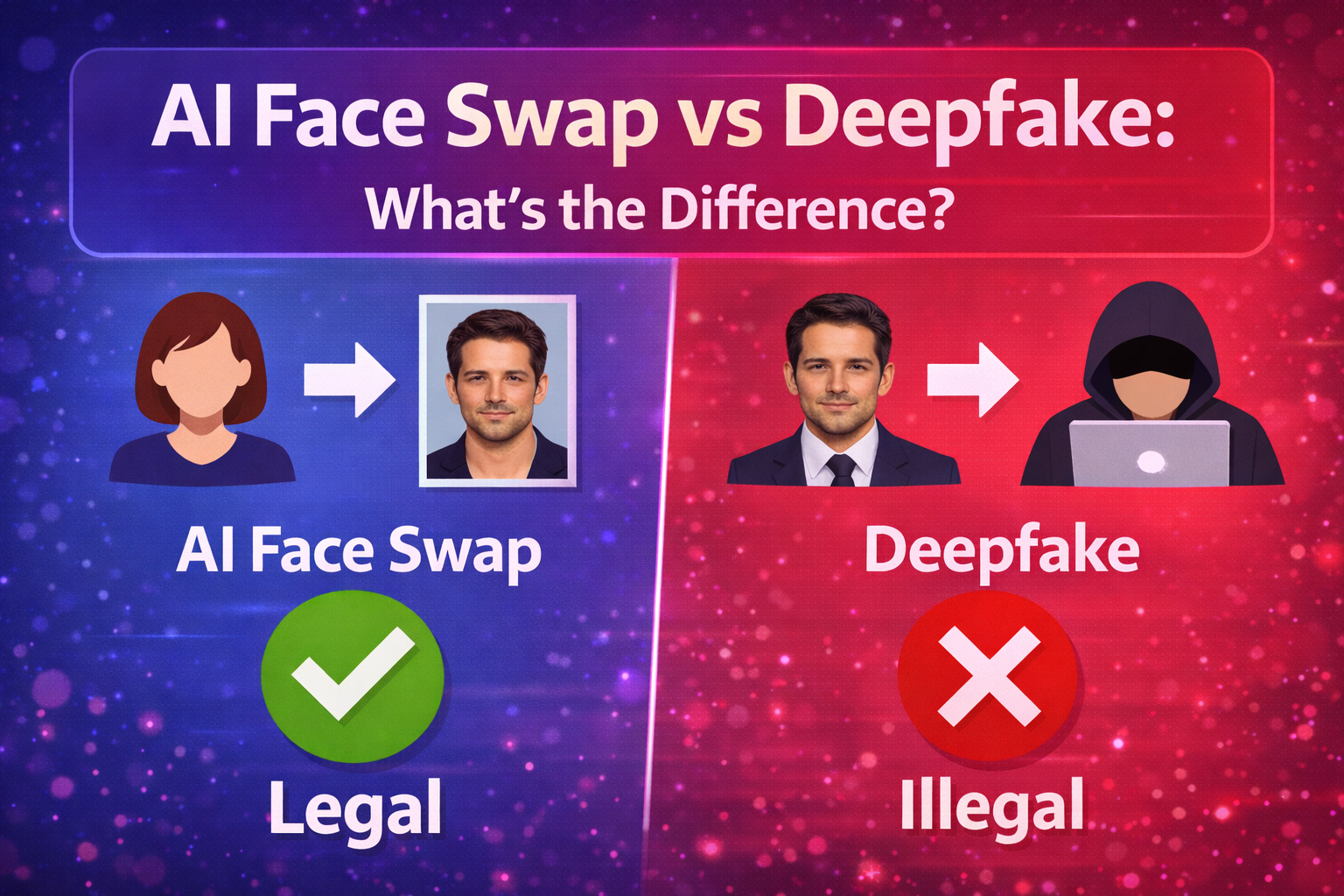
“Face swap” and “deepfake” get thrown around as synonyms. They’re not. One is a neutral technology term covering a wide range of creative tools. The other carries legal baggage, ethical red flags, and a reputation that can follow you offline. Confuse the two and you risk choosing the wrong tool — or landing on the wrong side of a law that’s tightening fast.
This guide breaks down what each term actually means, how the underlying technology differs, where the legal lines sit in 2026, and which tools belong in each category.
Definitions: Two Terms, Very Different Meanings
【位置】H2直下
【内容】左右2カードのデザイン。左カード「AI Face Swap」= 技術用語、幅広い用途。右カード「Deepfake」= 非同意、実在人物。対比を明確に
【サイズ】1200×675px、中央寄せ
【alt】AI face swap vs deepfake definition comparison infographic 2026
【ファイル名例】ai-face-swap-vs-deepfake-definitions.webp
AI Face Swap
A broad, neutral term for any AI technology that replaces one face with another in an image or video. The source face and target body can both be AI-generated, stock imagery, or user-created content. Use cases span entertainment, filmmaking, social media filters, creative projects, and adult content generation. The key distinction: face swap is a tool description, not a moral judgment.
Deepfake
A narrower, loaded term. Deepfake specifically refers to AI-manipulated media — usually video — that maps a real, identifiable person’s face onto another body without their consent. The word itself was coined on Reddit in 2017 to describe non-consensual celebrity face swaps, and it’s carried that stigma ever since. In legal and media contexts, “deepfake” almost always implies deception or harm.
The core split: deepfake implies a real person and no consent. AI face swap is the technology itself — what makes it ethical or unethical depends entirely on how you use it.
How the Technology Works
【位置】H2直下
【内容】上段:Face Swap(顔検出→ランドマーク→スキントーン→ブレンド=数秒)。下段:Deepfake(大量画像収集→GAN学習→フレーム生成=数時間〜数日)。処理フローを図解
【サイズ】1200×675px、中央寄せ
【alt】AI face swap vs deepfake technical workflow comparison diagram
【ファイル名例】ai-face-swap-vs-deepfake-how-it-works.webp
AI Face Swap: Fast and Accessible
Modern face swap tools use pre-trained neural networks that detect facial landmarks (eyes, nose, mouth, jawline), extract the source face, match skin tone and lighting to the target image, then blend the two seamlessly. The entire process runs in seconds and requires zero technical skill.
High-quality platforms like Image Nude handle lighting correction, angle adjustment, and skin color matching automatically. Upload two images, click generate, done. The output looks natural because the AI has been trained on millions of facial data points to understand how light, shadow, and skin interact from every angle.
Face swap also works exceptionally well with fully AI-generated images. Since AI-generated bodies already have consistent lighting and smooth skin rendering, the blending step produces cleaner results than real-photo sources.
Deepfake: Slow and Technical
Creating a deepfake is a fundamentally different process. You need hundreds — often thousands — of photos or video frames of one specific person’s face. A custom AI model (typically a GAN or autoencoder) trains on that dataset, learning the exact contours, expressions, and lighting responses of that individual face. Training eats hours to days of GPU time.
The result is a model that can paste that person’s face onto video frames convincingly, matching lip movements and expressions in real time. The technical barrier is high: you need a powerful GPU (16GB+ VRAM), familiarity with tools like DeepFaceLab, and patience for long training cycles.
This is why deepfakes are primarily video-based — the technology is designed to animate a face frame by frame. Still-image face swap uses lighter, faster models that don’t require person-specific training.
Side-by-Side Comparison
【位置】H2直下
【内容】7項目の比較表をアイコン付きビジュアルで表現。緑=良い、黄=注意、赤=リスク
【サイズ】1200×800px、中央寄せ
【alt】AI face swap vs deepfake side-by-side feature comparison chart 2026
【ファイル名例】ai-face-swap-vs-deepfake-comparison-chart.webp
| Factor | AI Face Swap | Deepfake |
|---|---|---|
| Primary format | Images (+ some video) | Video primarily |
| Technical difficulty | Easy — no skills needed | Complex — model training required |
| Generation speed | Seconds | Hours to days |
| Works with AI-generated images | Yes — best results | No — needs real face data |
| Requires target’s photos | No | Yes — hundreds needed |
| Legal for creative use | Yes (with AI or consented imagery) | Depends on subject and jurisdiction |
| Privacy risk | Low (when using AI imagery) | High (involves real people) |
| Cost | Free tiers available on most platforms | GPU hardware + electricity + time |
Legal Landscape in 2026
【位置】H2直下
【内容】世界地図上にFace Swap(合法エリア多い)とDeepfake(規制強化エリア)をカラーコード表示。米国、EU、UK、豪を強調
【サイズ】1200×675px、中央寄せ
【alt】AI face swap vs deepfake legal status by jurisdiction world map 2026
【ファイル名例】ai-face-swap-vs-deepfake-legal-map-2026.webp
Laws around AI-generated imagery are evolving rapidly. Here’s where things stand as of early 2026.
AI Face Swap — Generally Permissible
Using face swap on AI-generated imagery — where no real, identifiable person is depicted — is legal in most jurisdictions. The content is entirely synthetic: no real person’s likeness is used, no consent issue arises. Platforms like Image Nude operate in this space, ensuring all processed content is AI-generated with automatic deletion within one hour.
Face swapping your own photos or photos of consenting adults is also legal in most places, as long as the output isn’t used for fraud, harassment, or distribution without consent.
Deepfake — Increasingly Criminalized
Non-consensual deepfakes of real people face escalating legal consequences worldwide:
- United States: Over 40 states have enacted or proposed deepfake legislation as of 2026. Federal bills targeting non-consensual intimate deepfakes continue advancing. Penalties range from civil liability to criminal charges.
- European Union: The AI Act classifies deepfakes as high-risk AI applications requiring transparency labeling. Member states are adding criminal penalties for non-consensual intimate deepfakes.
- United Kingdom: The Online Safety Act criminalizes sharing non-consensual intimate deepfakes, with prison sentences up to two years.
- Australia: Federal legislation targets both creation and distribution of non-consensual deepfakes with significant fines and imprisonment.
The practical takeaway: AI face swap with synthetic imagery and deepfaking real people occupy fundamentally different legal categories. Same underlying technology, completely different consequences.
Best AI Face Swap Tools in 2026
【位置】H2直下
【内容】3つのプラットフォームカード(Image Nude、Reface、FaceMagic)を横並びで表示。各カードに特徴アイコン
【サイズ】1200×675px、中央寄せ
【alt】Best AI face swap tools 2026 platform comparison cards
【ファイル名例】ai-face-swap-best-tools-2026.webp
If you’re looking for face swap tools that operate ethically and legally, these platforms are designed for creative and AI-generated content:
Image Nude
The leading platform for NSFW AI face swap. Image Nude specializes in blending faces onto AI-generated bodies with photorealistic accuracy. Key features include automatic lighting and skin tone matching, one-hour image auto-deletion for privacy, and cryptocurrency payment support for anonymity. The free tier includes 20 credits to test the service. All content is processed as AI-generated — no real person imagery is accepted.
#1 Rated NSFW Face Swap — 20 Free Credits
AI-generated imagery only. Auto-deleted in 1 hour. Crypto accepted.
Reface
A mainstream face swap app focused on entertainment. Reface lets you swap faces into movie clips, GIFs, and memes. Strictly SFW, but useful for understanding how the technology works in a consumer-friendly package. Available on iOS and Android with a generous free tier.
FaceMagic
Another mobile-first face swap tool that handles both photos and short video clips. FaceMagic produces clean results with minimal artifacts and runs entirely on-device for privacy. Best for social media content creators who want quick, fun face swaps without cloud processing.
When to Use Each
Use AI Face Swap When:
- Creating adult AI imagery with fictional, AI-generated characters
- Applying a consistent character face across multiple AI-generated scenes
- Building character series for creative projects
- Making entertainment content (memes, social media) with your own face or with consent
- Working on film or video projects where all parties have consented
Avoid Deepfake Tools When:
- Working with images or video of real, identifiable people without their explicit consent
- The output could be mistaken for authentic footage of that person
- The intent is to deceive, harass, or distribute without authorization
- You’re unsure about the legal status in your jurisdiction
Frequently Asked Questions
Is AI face swap the same as deepfake?
No. AI face swap is a neutral technology term for blending one face onto another image or video. Deepfake specifically refers to AI-manipulated media of real people, typically created without consent. The technology overlaps, but the intent, use case, and legal implications are completely different.
Is AI face swap legal?
When used on AI-generated images or with consenting parties, yes — it’s legal in most jurisdictions. Using it to create non-consensual imagery of real, identifiable people is illegal in a growing number of countries and US states.
What is the best AI face swap tool for NSFW content?
Image Nude leads the NSFW AI face swap category in 2026. It delivers photorealistic results, protects privacy with automatic one-hour image deletion, and supports cryptocurrency payments for anonymous transactions.
Can AI face swap work on fully AI-generated images?
Yes — and this is actually where it produces the best results. AI-generated bodies have consistent lighting, smooth skin rendering, and uniform resolution, which makes face blending significantly cleaner than working with real photographs.
How can I tell if an image is a deepfake?
Look for telltale signs: inconsistent lighting between the face and body, blurring around the jawline or hairline, mismatched skin texture, teeth that look unnatural, and eyes that don’t track correctly. AI detection tools like Microsoft’s Video Authenticator and Intel’s FakeCatcher can also help identify manipulated media.