AI Image Generation Trends 2026: What’s Changed This Year
Twelve months ago, AI image generation was already impressive. Today, it’s barely recognizable compared to where it stood at the start of 2025. The jump in quality, speed, and capability between early 2025 and mid-2026 rivals the leap from 2022 to 2024—except this time, the improvements target specific weaknesses that users have complained about for years. Hands finally look right. Faces maintain consistency across dozens of images. Text renders cleanly. And generation times have dropped from minutes to seconds.
Here’s what has actually changed in AI image generation during 2026, with a focus on trends that matter for both mainstream and NSFW applications.
Trend 1: The Anatomy Problem Is Mostly Solved
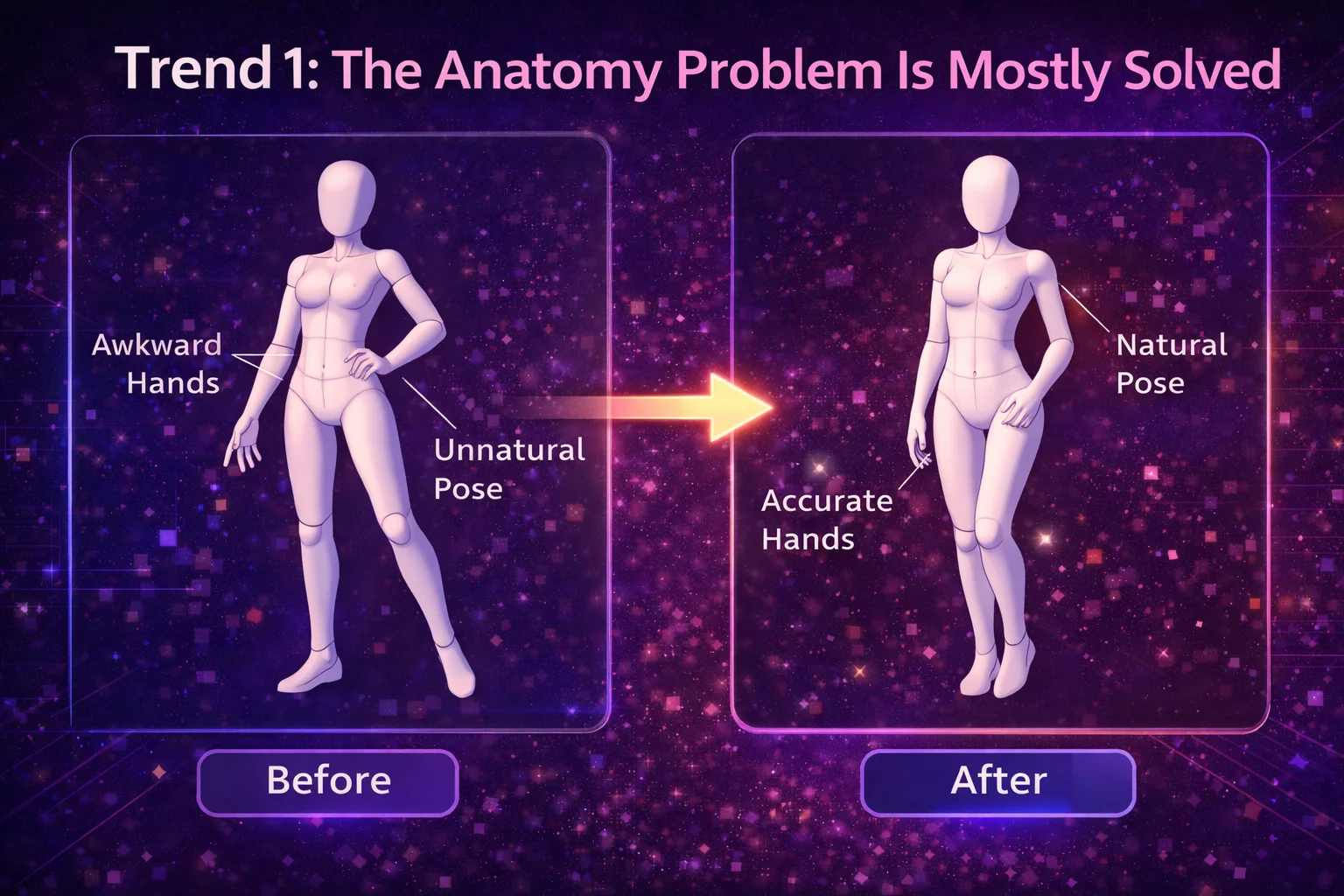
For years, the running joke about AI-generated images was the hands. Six fingers, fused digits, impossible joint angles—AI hands were an instant tell. That era is effectively over.
Current-generation models (Stable Diffusion 4.x, Flux Pro 2.0, and Midjourney v7) produce anatomically correct hands in roughly 95% of generations, up from approximately 70% in early 2025 and 40% in 2023. The improvement stems from two developments: better training data curation that over-represents hand imagery, and architectural changes that give models explicit structural understanding of body proportions.
The same improvements apply to full-body anatomy. AI images in 2026 handle complex poses—twisting torsos, overlapping limbs, unusual camera angles—with far fewer errors. For NSFW content specifically, this means explicit imagery that looks anatomically plausible rather than uncanny. The gap between AI-generated and photographed imagery continues to narrow, though trained eyes can still spot differences in skin texture and lighting consistency.
Trend 2: Character Consistency Across Multiple Images
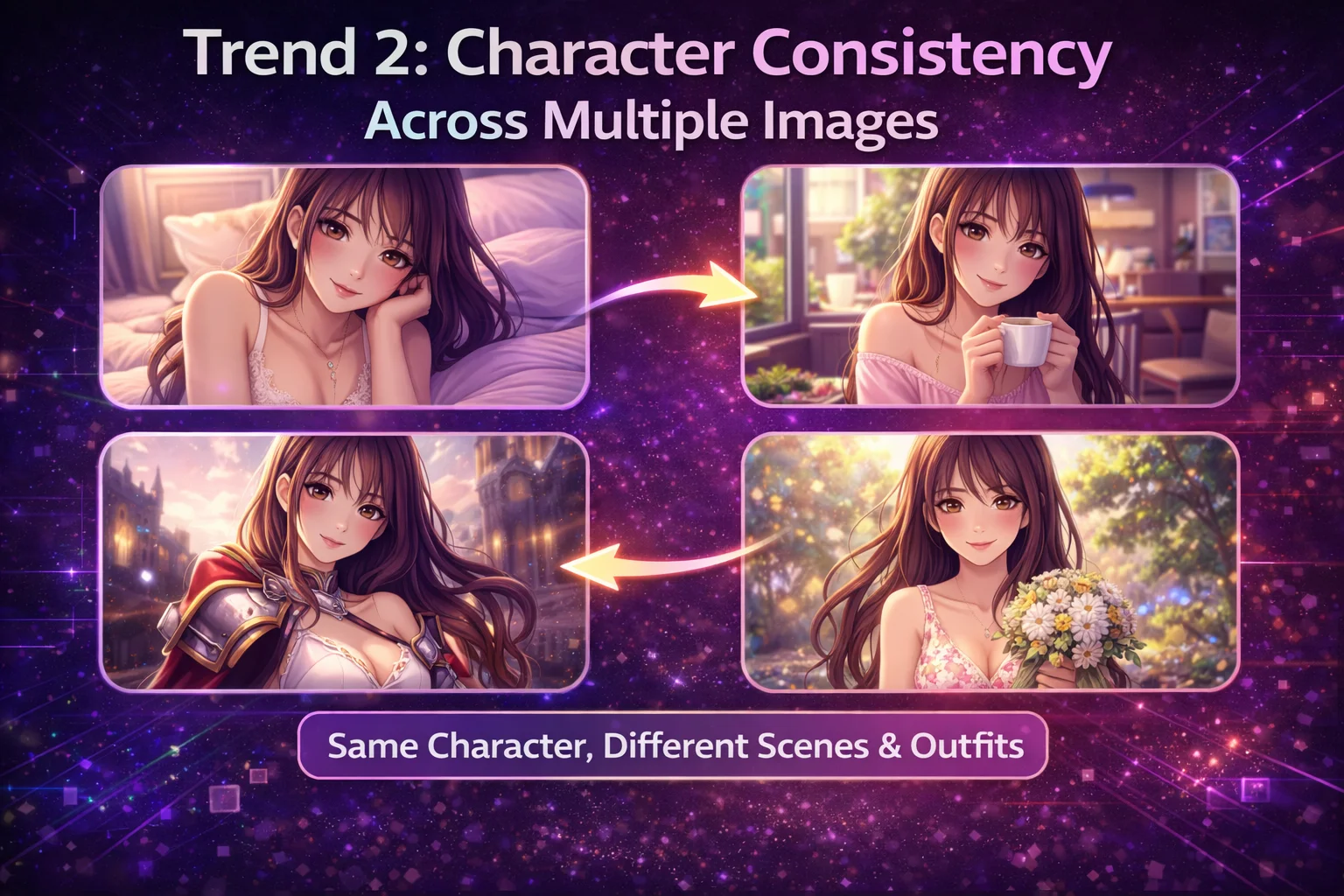
Generating a single great image was always possible with enough re-rolls. Generating the same character across 50 different images was nearly impossible until late 2025. That changed with the widespread adoption of character embedding techniques.
Platforms like Promptchan AI, Tensor.Art, and CivitAI now support character LoRAs (Low-Rank Adaptations) that let users train a consistent character identity from a handful of reference images. Generate 5–10 images of your character, train a LoRA in 15–30 minutes, and then produce unlimited additional images featuring that character in different poses, outfits, and settings.
For NSFW applications, character consistency is transformative. AI companion platforms use it to give each AI girlfriend a persistent visual identity. Content creators use it to build characters with ongoing narratives. The technology turns AI image generation from a slot machine (pull the lever and see what you get) into a directed creative tool.
IP-Adapter and InstantID techniques offer a lighter alternative—no training required, just upload a reference image and the model matches the face in new generations. Quality isn’t quite as high as dedicated LoRA training, but the zero-setup convenience makes it popular for casual use.
Trend 3: Real-Time and Near-Real-Time Generation
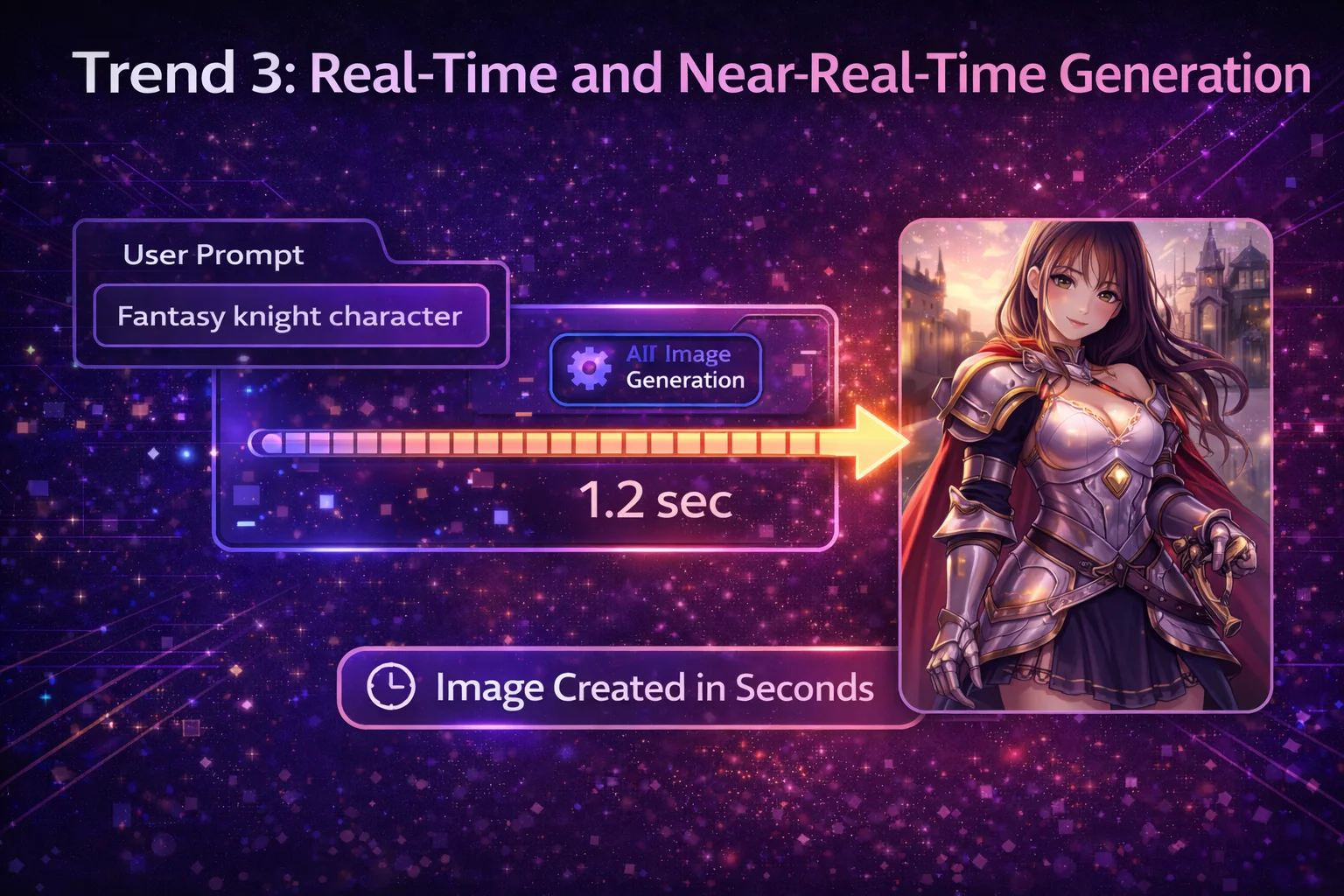
Generation speed has accelerated dramatically. Standard image generation that took 15–30 seconds in 2024 now completes in 2–5 seconds on optimized platforms. Some tools offer sub-second generation using distilled models, though at a quality tradeoff.
The speed improvements come from several technical advances working in parallel. Model distillation reduces the number of computational steps needed per image. Flash attention mechanisms process data more efficiently on modern GPUs. Caching and speculative techniques reuse computation across similar prompts. Infrastructure optimization—including purpose-built hardware from companies like Groq and Cerebras—pushes throughput higher.
Near-real-time generation enables new use cases that weren’t practical when each image took 20+ seconds. Interactive character posing (adjust a slider, see the result instantly), live chat image responses (an AI companion sends a relevant image within 2 seconds of a message), and rapid iteration on creative concepts all become viable.
For NSFW platforms, speed directly translates to engagement. Users generate more images per session when generation is fast, which increases both satisfaction and revenue on credit-based platforms.
Trend 4: Video Generation Enters the NSFW Space
2025 was the year AI video generation proved it could work. 2026 is the year it’s becoming commercially viable for adult content. Multiple platforms now offer NSFW video generation, producing 3–10 second clips from text prompts or from a starting image.
Quality varies significantly. The best current NSFW video generators produce footage that’s roughly comparable to where image generation stood in early 2024—impressive in short bursts but clearly AI-generated to attentive viewers. Common artifacts include temporal inconsistency (features shifting between frames), unnatural motion (particularly in complex physical interactions), and resolution limitations (most output at 720p or below).
Despite these limitations, NSFW AI video is growing fast. Platforms report that video features drive 30–50% higher engagement than images alone. Users are willing to accept lower quality in video format because the medium itself is more compelling. Early adopters are paying premium prices ($0.50–$2.00 per video clip compared to $0.05–$0.15 per image) that make the economics attractive for platforms despite higher compute costs.
Expect NSFW video quality to match current image quality within 12–18 months based on the rate of improvement in underlying models.
Trend 5: Local Generation Goes Mainstream
Running AI image generation locally—on your own computer, with no cloud service involved—has shifted from a hobbyist activity to a mainstream option. The combination of more efficient models, better software interfaces, and increasingly powerful consumer GPUs has lowered the barrier substantially.
In 2024, effective local NSFW generation required an NVIDIA GPU with at least 8GB VRAM, technical knowledge of command-line tools, and willingness to debug Python dependencies. In 2026, applications like ComfyUI, Forge, and several commercial local generation tools offer one-click installation and graphical interfaces. Models optimized for Apple Silicon run acceptably on MacBook Pro hardware. Even laptops with mid-range dedicated GPUs can produce quality images in 10–20 seconds.
The local generation trend matters for the NSFW market because it represents both competition and expansion. Users who generate locally don’t pay platform subscriptions, but they also represent a market segment that wasn’t previously reachable—people unwilling to upload NSFW prompts to a cloud service due to privacy concerns. The total number of people generating NSFW AI images grows, even if not all of them are paying customers of commercial platforms.
CivitAI reports over 15 million unique monthly users browsing and downloading models, with NSFW-tagged models accounting for approximately 40% of all downloads. The most popular NSFW checkpoint models have been downloaded tens of millions of times each.
Trend 6: Inpainting and Editing Replace Regeneration
The workflow for AI image creation has evolved. Rather than generating an entire image from scratch and re-rolling until the result is acceptable, 2026 workflows emphasize editing and refinement.
Advanced inpainting lets users select specific regions of an image and regenerate just those areas while keeping everything else fixed. Don’t like the face? Mask it and regenerate. Want to change the outfit? Select the clothing area and describe what you want instead. This targeted editing approach produces better results faster than full regeneration because users keep the elements they like and only redo what needs improvement.
ControlNet and similar structural guidance tools have also matured. Users can provide a pose skeleton, depth map, or rough sketch, and the AI fills in photorealistic detail while following the specified structure exactly. For NSFW content, this means precise control over poses and compositions that were previously hit-or-miss.
The shift from “generate and pray” to “generate and refine” has made AI image creation more predictable and professional. Skilled users can produce exactly what they envision in 5–10 minutes rather than spending an hour re-rolling prompts.
Trend 7: Style Diversity Explodes
Early NSFW AI images tended to converge on a narrow range of styles—hyper-realistic with smooth skin, anime with standard proportions, or a limited set of artistic filters. The variety available in 2026 is dramatically broader.
Community-created style LoRAs and checkpoints on platforms like CivitAI cover everything from oil painting to watercolor, comic book to vintage photography, pixel art to Art Nouveau. Specific anime sub-styles (90s anime, modern anime, chibi, semi-realistic anime) each have multiple high-quality models. Photorealistic models now differentiate between film stocks, camera types, and lighting setups.
This style diversity matters because it expands the creative possibilities and the audience. Users who aren’t interested in photorealistic NSFW content might engage with anime, comic, or artistic styles. Content creators can differentiate their work through distinctive visual styles rather than competing purely on subject matter.
Trend 8: Prompt Engineering Is Becoming Less Important
A counterintuitive trend: as models get smarter, prompts can get simpler. Current-generation models understand natural language descriptions far better than their predecessors, reducing the need for complex prompt engineering with specific keywords, weights, and syntax.
In 2024, getting a good result often required prompts like: “masterpiece, best quality, 8k, photorealistic, detailed skin texture, professional lighting, (beautiful face:1.3), (detailed eyes:1.2)…” The quality tags and weighted emphasis were necessary because models didn’t reliably produce high-quality output from plain descriptions.
In 2026, a simple natural language description—”a woman with red hair sitting in a cafe, afternoon sunlight, photorealistic”—produces comparable results on current models. The models default to high quality. Negative prompts are still useful for avoiding specific artifacts, but the extensive quality-boosting keyword lists are largely unnecessary.
This shift lowers the barrier to entry. New users no longer need to spend weeks learning prompt syntax to produce good results. Platforms benefit because lower barriers mean more users reach satisfying results quickly, which improves conversion and retention rates.
Trend 9: AI-Generated Content Detection Improves—And Fails
Detection tools for AI-generated images have improved significantly in 2026. Academic and commercial systems claim 90–98% accuracy on certain benchmarks. Companies like Hive Moderation, Content Credentials, and Illuminarty offer detection APIs that platforms use to flag AI-generated content.
But the detection arms race remains lopsided in favor of generators. Every detection breakthrough is followed by generation techniques that defeat it. Post-processing methods—adding noise, adjusting JPEG compression, applying subtle filters—reduce detection accuracy to 60–70% even with current tools. The C2PA metadata standard for content provenance is gaining adoption among mainstream AI companies, but NSFW platforms and local generation tools rarely implement it.
The practical result: AI-generated NSFW imagery is increasingly difficult to distinguish from photographs, both for human viewers and automated systems. This has implications for platform moderation, legal evidence, and personal privacy that extend well beyond the AI industry.
Trend 10: Pricing Pressure Pushes Platforms Toward Bundles
The cost of generating a single AI image has dropped by approximately 80% since 2024, from roughly $0.04–$0.08 per image to $0.008–$0.015 per image at the infrastructure level. This cost reduction hasn’t translated directly into lower consumer prices—most platforms have kept per-image pricing stable while increasing the number of images included in subscription plans.
The pricing pressure is pushing platforms toward bundled offerings. Rather than competing on image generation price (a race to the bottom), platforms bundle image generation with chat, voice, video, and community features at a higher overall price point. A $19.99/month subscription that includes text chat, 200 image generations, and 10 voice messages captures more value than a $9.99/month subscription for 300 images alone.
This bundling trend advantages larger platforms with the resources to build multimodal feature sets and disadvantages single-purpose image generators that compete primarily on price. Expect continued consolidation as standalone image generators either add companion features or get absorbed by broader platforms.
What to Watch for the Rest of 2026
Several developments are likely to shape the remainder of 2026. Full-body video generation with consistent characters could reach commercial quality by Q4 2026. Apple’s expected improvements to on-device AI processing in the next iPhone generation could make mobile-local NSFW generation feasible. Regulatory action in the EU and several U.S. states will test whether legislation can effectively constrain NSFW AI generation without breaking mainstream AI tools.
The pace of change shows no signs of slowing. If anything, the combination of better models, cheaper compute, and growing user demand is accelerating the evolution of AI image generation across all categories—NSFW included.