The State of AI Nudification: Ethics, Legality & Technology
No corner of the AI industry draws more controversy than nudification—the use of artificial intelligence to generate nude or explicit versions of clothed images. The technology has existed in some form since 2019 when the original DeepNude application appeared and was pulled offline within days. Since then, dozens of services have replicated and improved upon the concept, creating an industry that generates over a billion dollars annually while operating in legal and ethical grey zones that vary dramatically by jurisdiction.
This article examines the current state of AI nudification across three dimensions: the technology that makes it possible, the legal frameworks that attempt to govern it, and the ethical arguments on all sides.
How AI Nudification Works
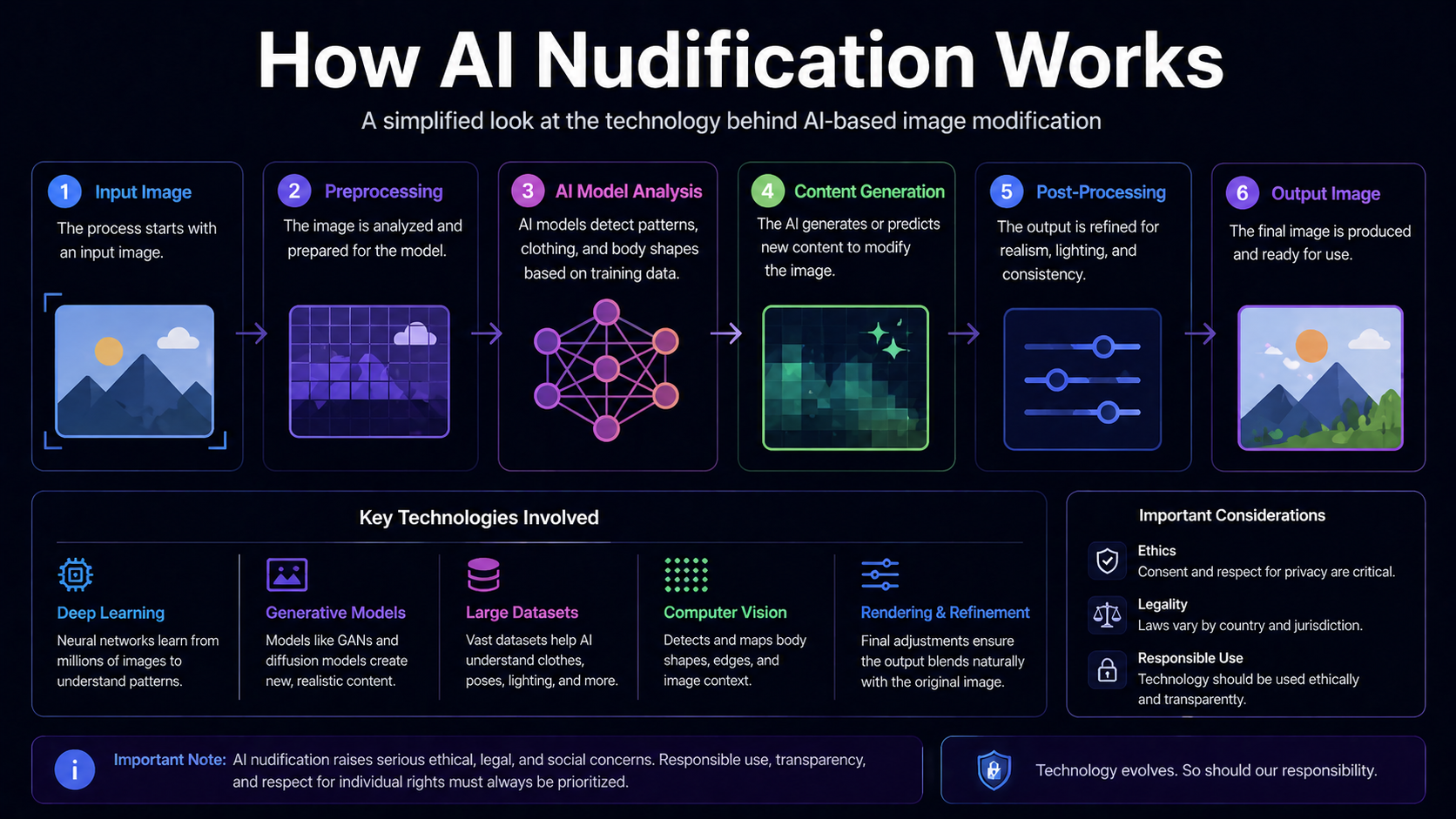
Understanding the ethical and legal debates requires understanding the technology itself. AI nudification tools use deep learning models—typically variants of generative adversarial networks (GANs) or diffusion models—trained on large datasets of paired clothed and unclothed images.
The Technical Process
Modern nudification tools follow a multi-step process. First, the system analyzes the input image to detect the human body, identify clothing boundaries, and estimate body shape and pose beneath the clothing. This uses techniques similar to those in augmented reality try-on tools used by fashion retailers.
Second, the system generates the underlying body. Rather than simply removing clothing pixels and revealing what’s “underneath” (nothing is underneath—it’s a flat image), the AI generates entirely new pixel data representing what a nude body would plausibly look like given the visible cues: body proportions estimated from the clothed figure, skin tone matched from visible areas like the face and arms, and pose and angle derived from the overall body position.
Third, the system composites the generated nude body back into the original image, matching lighting, resolution, and image characteristics. Advanced tools handle shadows, reflections, and background elements to create a more convincing result.
The output is a fabricated image. It does not reveal the actual body of the person photographed—it generates a synthetic approximation. This distinction matters for both legal and ethical analysis, though it provides limited comfort to people whose clothed images have been processed without their consent.
Quality and Accuracy
Current nudification technology produces results that range from obviously fake to disturbingly convincing, depending on the input image quality, the model used, and the complexity of the clothing and pose.
Best-case scenarios—clear frontal photos with simple clothing—can produce outputs that casual viewers cannot distinguish from real photographs. Worst-case scenarios—complex poses, patterned clothing, unusual lighting—produce visible artifacts and unrealistic anatomy.
The average quality has improved approximately 60% since 2024 based on user satisfaction surveys conducted by major platforms. Improvements in skin texture rendering, lighting consistency, and anatomical accuracy have been the primary drivers.
Legal Status by Jurisdiction
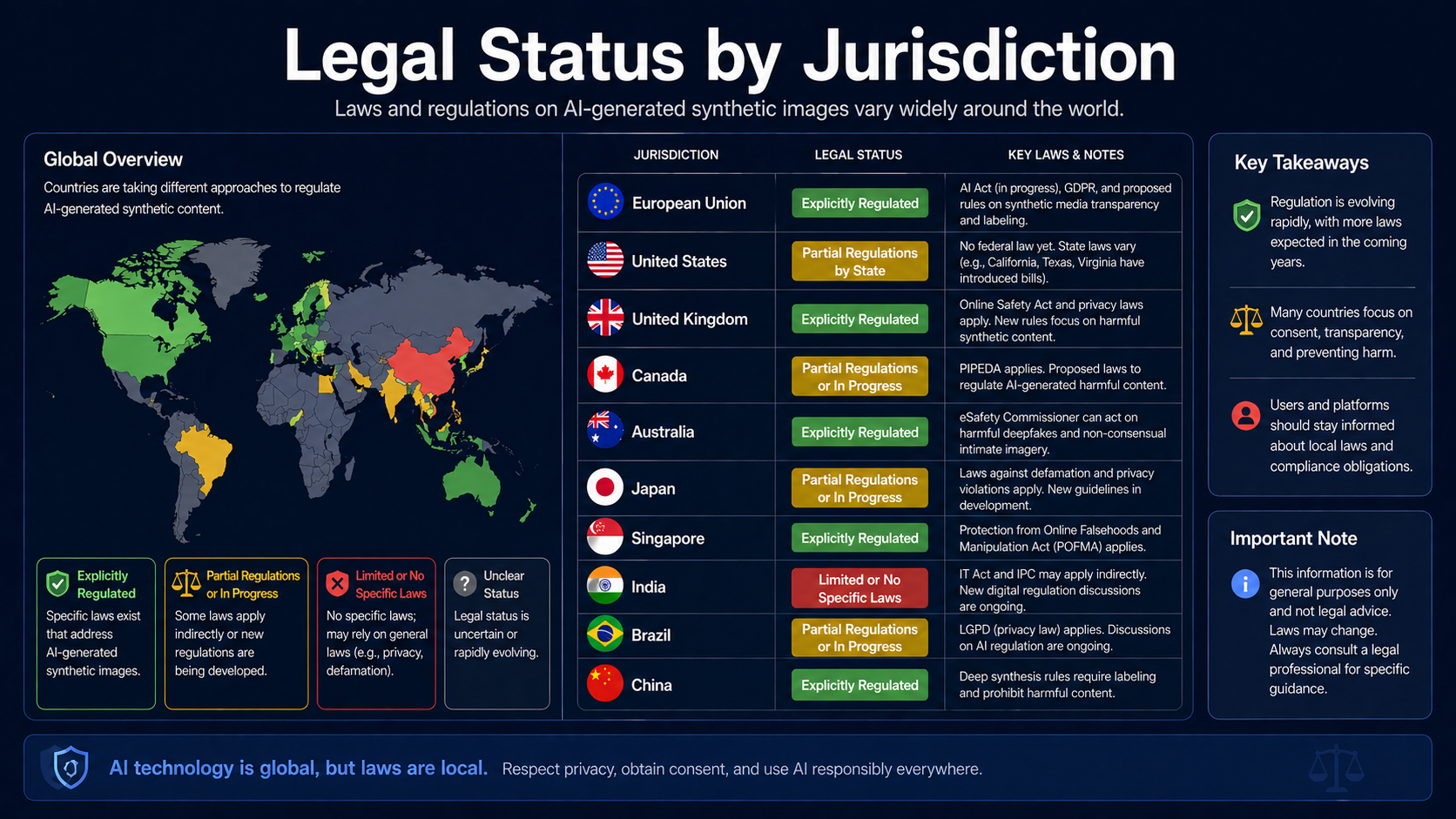
The legal treatment of AI nudification varies enormously across countries and, within the United States, across states. The legal situation is evolving rapidly, with new legislation proposed or enacted regularly.
United States
There is no federal law specifically banning AI nudification of adults as of Q1 2026. However, several federal statutes may apply depending on circumstances. The creation and distribution of AI-generated CSAM (child sexual abuse material) is explicitly illegal under federal law, regardless of whether the depicted minor is real.
At the state level, the picture is more complex. As of early 2026, approximately 30 states have enacted or are actively considering legislation addressing non-consensual intimate imagery (NCII) that includes AI-generated content. Key state approaches include:
- California (AB 602 and subsequent amendments): Prohibits the creation and distribution of digitally altered sexual imagery of real people without consent. Provides civil remedies and, in some cases, criminal penalties. The 2025 amendments explicitly include AI-generated content.
- Texas (SB 1361): Criminalizes deepfake pornography depicting real individuals without consent. Penalties include up to 1 year in jail and fines up to $4,000.
- New York: Civil cause of action for non-consensual distribution of digitally altered intimate images. Strong protections but enforcement has been limited.
- Virginia: Updated revenge porn statute to include AI-generated content. Criminal penalties for distribution.
The state-by-state approach creates a patchwork where the same action may be legal in one state and criminal in another.
European Union
The EU’s approach combines the AI Act, GDPR, and national criminal laws. The AI Act classifies AI systems that generate manipulated imagery of real persons as “limited risk,” requiring transparency disclosures (the output must be labeled as AI-generated). GDPR’s provisions on personal data arguably apply to nudification—processing someone’s image to create explicit content likely violates multiple GDPR principles, including purpose limitation and lawful basis for processing.
Individual EU member states have enacted varying criminal provisions. Germany’s Section 201a StGB (violation of intimate privacy) has been interpreted to cover AI-generated intimate images. France updated its harassment and privacy laws in 2024 to explicitly include AI-generated intimate content. Spain, Italy, and the Netherlands have similar provisions at various stages of implementation.
United Kingdom
The UK criminalized the creation of non-consensual intimate deepfakes under the Online Safety Act 2023, with penalties of up to two years in prison. The Act specifically addresses AI-generated intimate imagery and applies to creation, not just distribution—meaning generating such an image is illegal even if it’s never shared.
South Korea
South Korea has enacted some of the world’s strictest laws against AI-generated intimate imagery, driven by a series of high-profile cases involving deepfake content targeting Korean women. Penalties include up to 5 years in prison and fines up to 50 million won (approximately $37,000). Enforcement has been active, with dozens of prosecutions since 2024.
Australia
Australia criminalized non-consensual sharing of intimate images in 2018, and subsequent amendments expanded the definition to include AI-generated content. The eSafety Commissioner has authority to issue takedown notices and impose civil penalties on platforms hosting such content.
The Ethics Debate
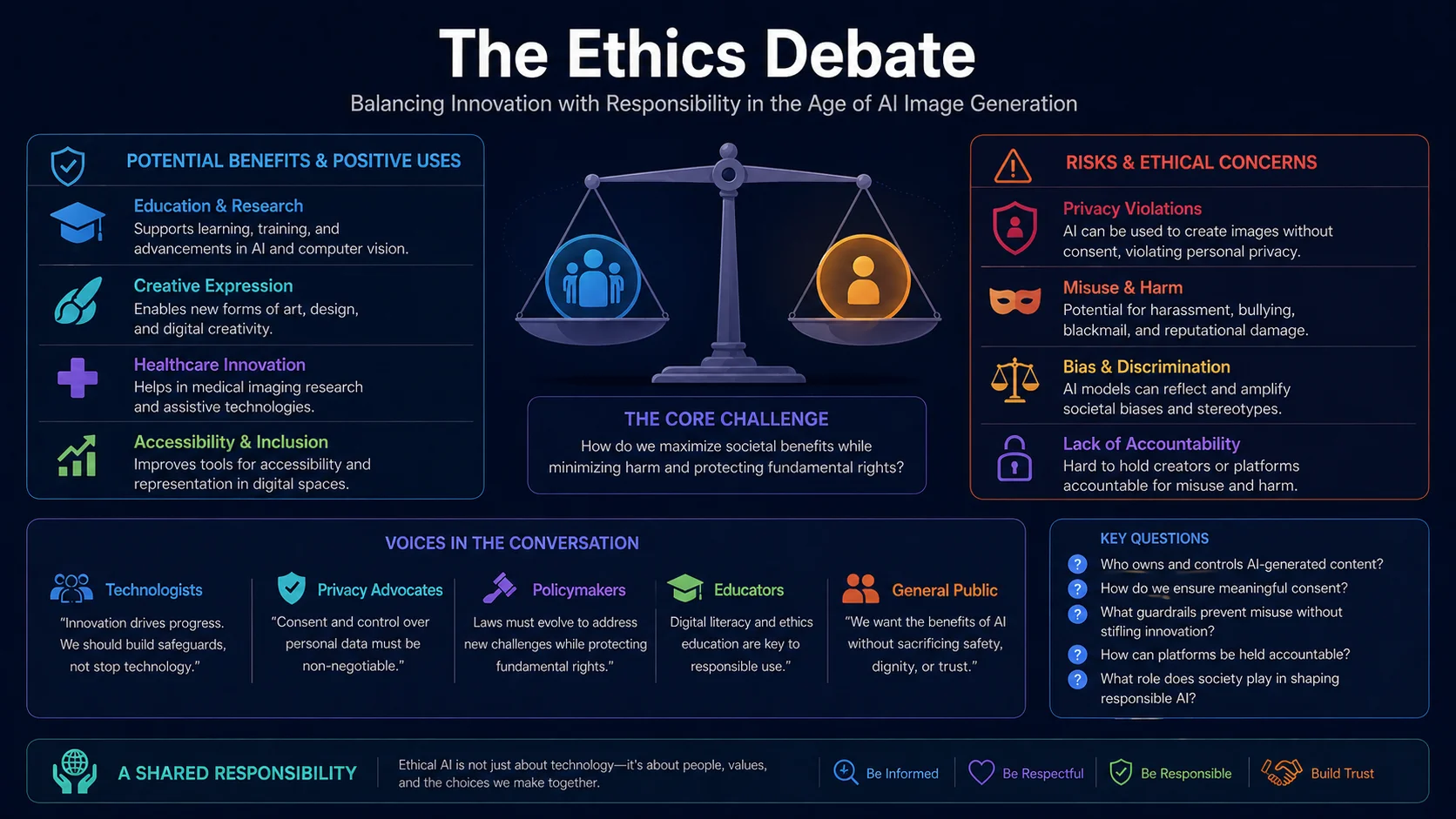
The ethical arguments around AI nudification extend beyond simple legal compliance. Multiple frameworks and perspectives apply, and they don’t all reach the same conclusions.
The Consent Argument
The strongest ethical argument against nudification is straightforward: using someone’s image to generate sexual content without their consent violates their autonomy and dignity. This argument applies regardless of whether the output is technically “real”—the harm is in the sexualization of a real person against their will.
Victims report psychological impacts comparable to those experienced by victims of traditional non-consensual intimate image distribution: anxiety, depression, social withdrawal, and damage to personal and professional relationships. The fact that the images are “fake” doesn’t prevent the emotional harm when they’re distributed in contexts where viewers may believe them to be real.
Research from the Cyber Civil Rights Initiative found that 93% of victims of non-consensual intimate imagery (including AI-generated) reported significant emotional distress, and 51% reported suicidal thoughts. These numbers are consistent with earlier studies on traditional revenge pornography.
The Technology Neutrality Argument
Some technology advocates argue that nudification tools themselves are neutral—like Photoshop or any image editing software, they can be used ethically or unethically depending on the user’s intent and actions. Under this framework, the tool isn’t the problem; misuse is the problem, and regulations should target misuse rather than the technology itself.
This argument has some merit in theory but faces practical challenges. Unlike general-purpose image editors, nudification tools are designed specifically for one purpose. The argument that they have legitimate uses is harder to sustain when the primary and often sole function is generating non-consensual intimate imagery.
Potential legitimate uses do exist: consensual couples using the technology on their own images, artists exploring body and form, and medical visualization. But these use cases represent a small fraction of actual usage. Platform data from leaked internal documents suggests that 85–95% of images processed by nudification tools are non-consensual—meaning the person depicted did not provide or could not provide consent to the processing.
The Free Expression Argument
In jurisdictions with strong free expression protections, particularly the United States under the First Amendment, some argue that generating AI images—even explicit ones—constitutes protected expression. The argument is that creating a digital image is an act of expression regardless of content, and government restrictions on such creation face strict scrutiny.
Courts haven’t fully resolved this question. The few cases that have been litigated have generally focused on distribution rather than creation. Legal scholars are divided on whether creation alone (without distribution) of AI-generated intimate imagery of a real adult would survive First Amendment analysis. The question may reach the U.S. Supreme Court within the next few years.
The Harm Reduction Argument
A less commonly discussed perspective focuses on harm reduction. Some researchers argue that attempting to ban nudification technology entirely is futile—open-source models can run locally and cannot be effectively regulated. Under this framework, the focus should shift to reducing harm through education, rapid takedown mechanisms, legal penalties for distribution, and technical tools that help victims identify and remove unauthorized images.
This argument doesn’t endorse nudification but accepts its existence as a technological reality and focuses on practical measures to minimize damage. Advocates point to the failed war on file-sharing piracy as an analogy: prohibition didn’t work, but building better legitimate alternatives (streaming services) and focusing enforcement on commercial-scale infringement did reduce harm.
Industry Self-Regulation
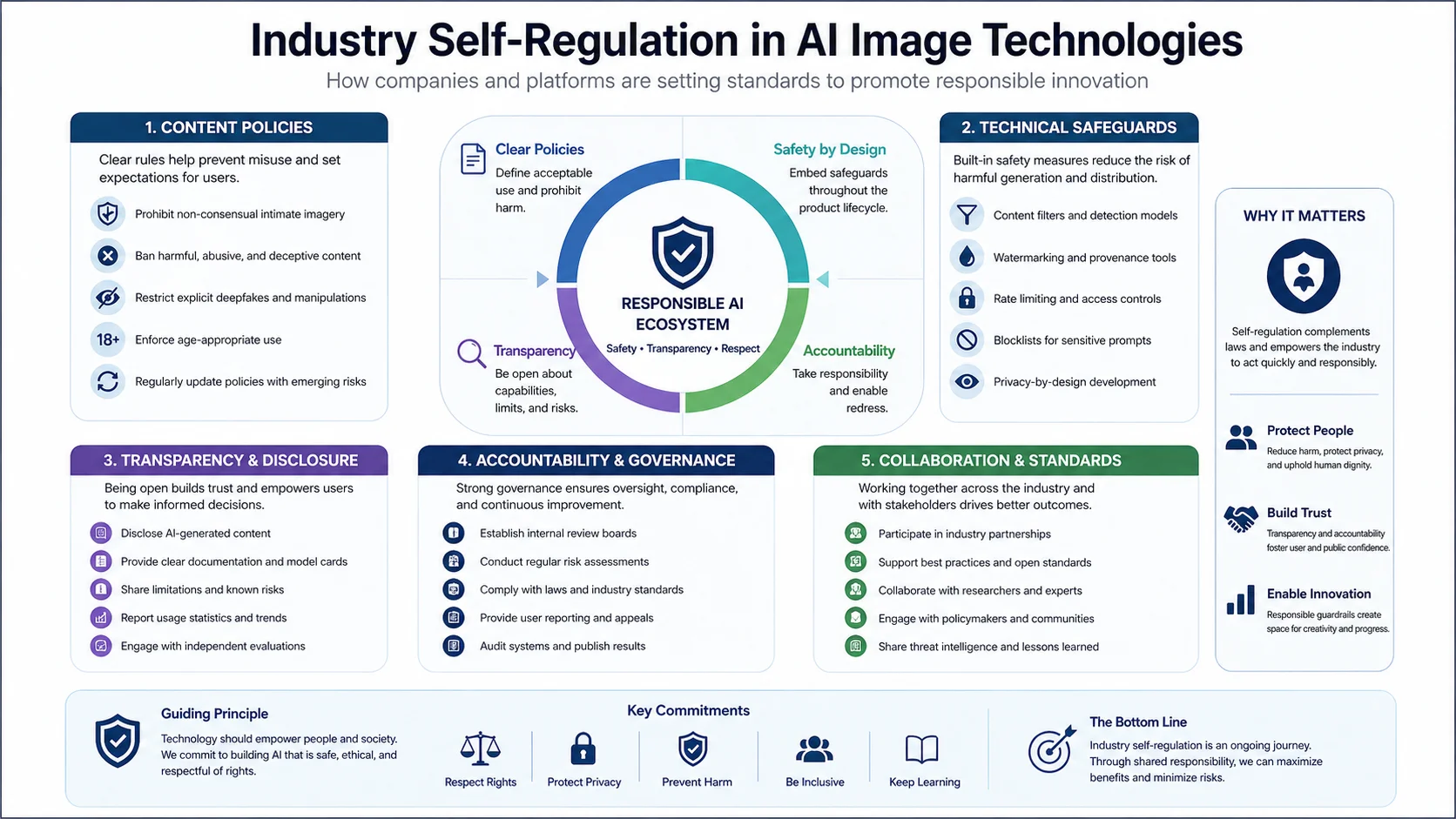
The nudification industry’s approach to self-regulation has been inconsistent at best. Some patterns have emerged in 2025–2026.
Age verification: Most major platforms now implement some form of age verification, though the rigor varies. Photo ID verification is becoming standard on larger platforms, while smaller services may rely on checkbox confirmation only.
Consent claims: Several platforms now require users to confirm they have the consent of the person depicted or that the image is of themselves. This provides legal cover for the platform but is unenforceable in practice—there’s no way to verify such claims.
Celebrity and public figure blocking: Some platforms maintain databases of public figure images and reject inputs that match. This protects against the most visible form of misuse but doesn’t address private individuals.
Watermarking: A growing number of platforms embed invisible watermarks in output images that identify the generating platform and, in some cases, the user account. This creates accountability but can be defeated by post-processing.
Minor detection: All major platforms implement AI-based detection systems that attempt to identify and reject images of minors. The technology is imperfect but has improved significantly, and platforms that fail to implement it face severe legal liability.
Platform and Payment Processor Responses
The infrastructure layer has become a primary enforcement mechanism against nudification platforms.
Apple and Google ban nudification apps from their app stores. Major web hosting providers (AWS, Google Cloud, Cloudflare) have terms of service that prohibit non-consensual intimate imagery, though enforcement against nudification services specifically has been inconsistent.
Payment processors have taken the strongest action. Visa and Mastercard have restricted processing for nudification services, forcing platforms onto high-risk payment processors or cryptocurrency. PayPal explicitly prohibits nudification services. Stripe evaluates on a case-by-case basis but generally declines these businesses.
These infrastructure-level restrictions have been more effective than legal action in constraining the market. When a nudification platform loses its payment processor, it typically sees 60–80% revenue decline even if it remains technically accessible.
The Path Forward
Several developments are likely to shape the nudification space in the coming years.
Legal convergence: The patchwork of laws is gradually converging toward criminalization of non-consensual intimate AI imagery. Within 3–5 years, most developed nations will have specific legislation addressing the issue. Whether these laws will be effectively enforced against individual users running local models is another question entirely.
Technical countermeasures: Research into anti-nudification technology—techniques that make images resistant to AI manipulation—is advancing. Methods like Glaze and Nightshade (originally developed to protect artists’ styles) are being adapted to protect personal photos from nudification. These aren’t foolproof but raise the difficulty and reduce output quality.
Social norms: Public awareness of AI-generated intimate imagery has increased significantly. As understanding grows, social norms around creating and sharing such content may shift, much as attitudes toward traditional revenge pornography shifted from dismissive to condemnatory over the past decade.
The technology itself will continue to improve regardless of legal or ethical constraints. Open-source models ensure that nudification capability cannot be permanently restricted at the technical level. The question is not whether the technology will exist, but how societies choose to govern its use and support its victims. The answers being developed in 2026 will shape the relationship between AI, privacy, and consent for decades to come.