AI Deepfake Laws 2026: What You Need to Know by Country
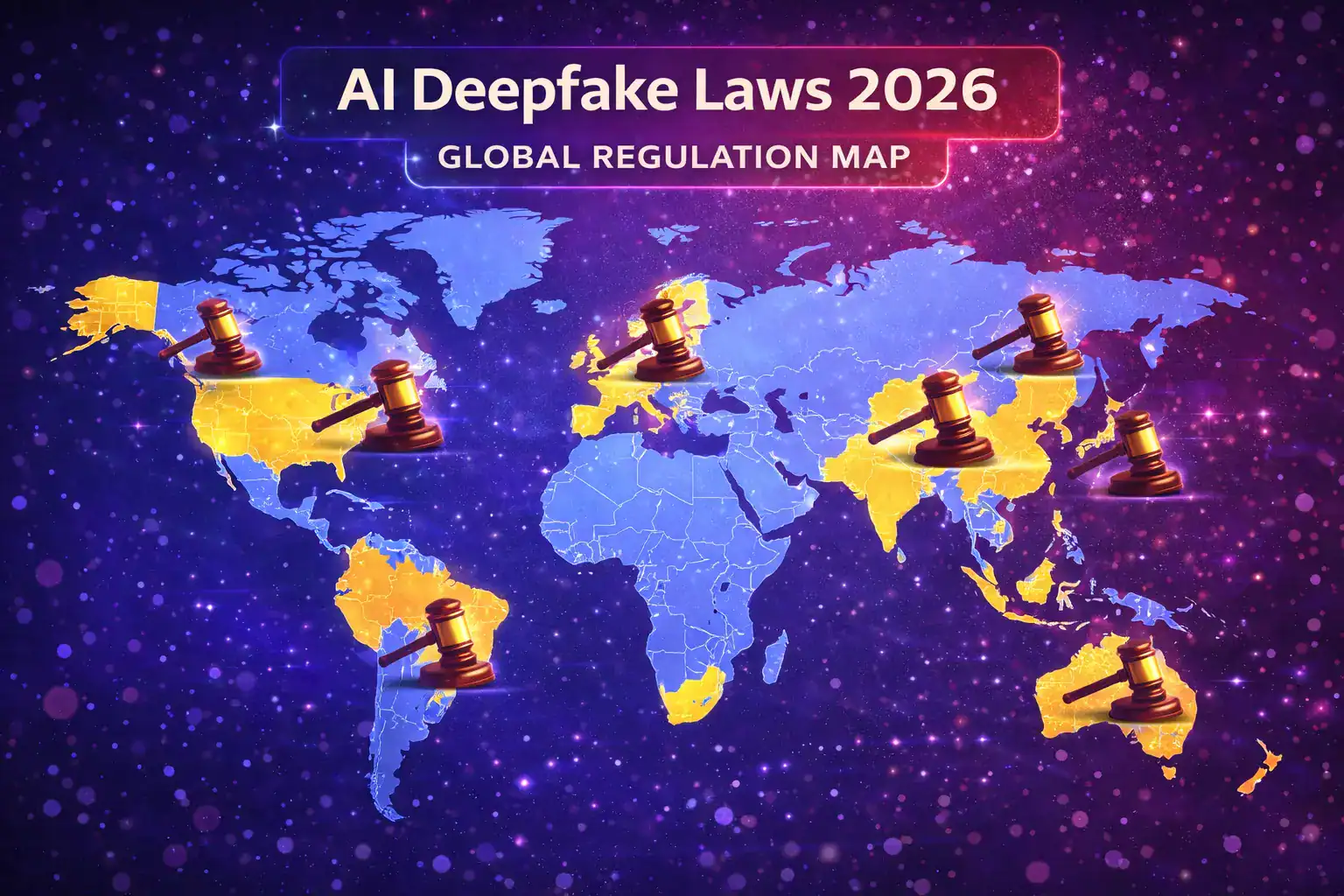
Two years ago, most countries had no laws specifically addressing AI deepfakes. Today, over 40 nations have enacted or are actively drafting legislation targeting synthetic media. The regulatory response has been uneven—some jurisdictions impose prison sentences for creating non-consensual deepfakes, while others haven’t addressed the issue at all. This guide maps the current legal treatment of AI deepfakes across major jurisdictions, covering both sexual and non-sexual deepfakes, and distinguishing between laws that target creation, distribution, and possession.
Defining “Deepfake” in Legal Context
Before examining specific laws, it’s worth noting that jurisdictions define deepfakes differently. Most legal frameworks use variations of terms like “synthetic media,” “digitally altered imagery,” “AI-generated manipulated content,” or “computer-generated intimate imagery.” Some laws are technology-neutral (covering any method of creating fake imagery), while others specifically reference artificial intelligence or machine learning.
This distinction matters. Technology-neutral laws cover deepfakes created by any means—AI, Photoshop, or traditional film editing—while AI-specific laws may not cover manually created fakes. Most recent legislation uses technology-neutral language to avoid becoming obsolete as techniques evolve.
United States
Federal Law
As of Q1 2026, the United States has no comprehensive federal deepfake law. Several bills have been introduced but none have passed both chambers of Congress.
DEFIANCE Act (proposed): Would create a federal civil cause of action for victims of non-consensual intimate deepfakes. Allows victims to sue creators and distributors for damages. Passed the Senate in 2024 but stalled in the House. A revised version was reintroduced in early 2026.
DEEPFAKES Accountability Act (proposed): Would require all deepfake content to carry a digital watermark identifying it as synthetic media. Has not advanced past committee.
Existing federal statutes that may apply:
- 18 U.S.C. § 2256 — Federal child exploitation laws apply to AI-generated CSAM regardless of whether a real child was involved.
- FTC Act — The FTC has authority to pursue deepfakes used for fraud or deceptive commercial practices.
- Wire fraud statutes — Deepfakes used to commit financial fraud fall under existing wire fraud laws.
State Laws
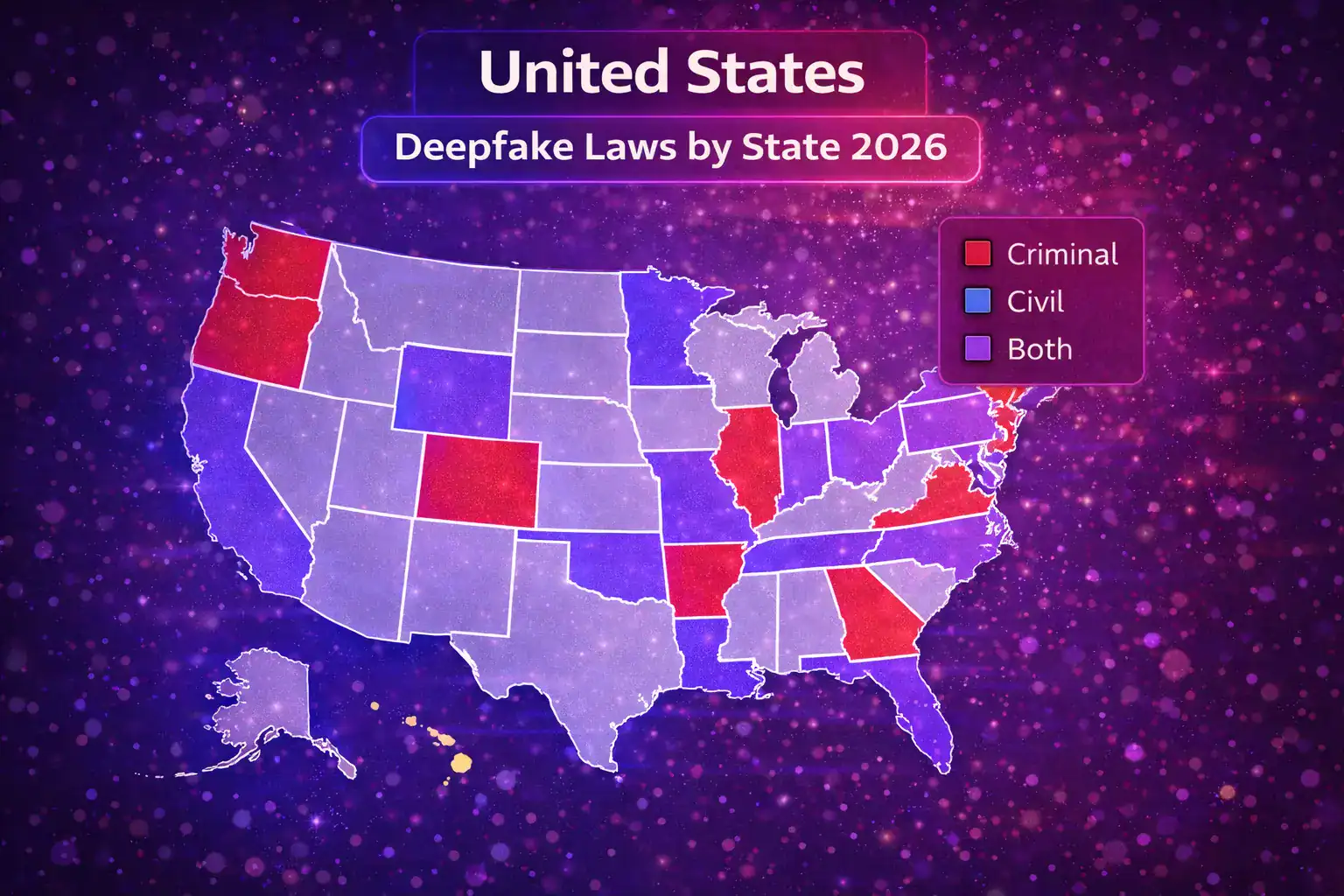
The absence of federal legislation has pushed action to the state level. As of early 2026, the following states have enacted deepfake-specific laws:
| State | Type of Law | What It Covers | Penalties |
|---|---|---|---|
| California | Civil + Criminal | Non-consensual intimate deepfakes; election deepfakes | Civil damages; misdemeanor for distribution |
| Texas | Criminal | Non-consensual intimate deepfakes | Class A misdemeanor (up to 1 year jail, $4,000 fine) |
| Virginia | Criminal | Non-consensual intimate images (including AI-generated) | Class 1 misdemeanor; felony for minors |
| New York | Civil | Non-consensual intimate deepfakes | Civil damages up to $250,000 |
| Minnesota | Criminal + Civil | Non-consensual deepfake dissemination | Gross misdemeanor; civil action for damages |
| Georgia | Criminal | Non-consensual intimate deepfakes | Felony (1-5 years prison) |
| Florida | Criminal | Deepfakes involving minors; non-consensual intimate deepfakes | Felony for minors; misdemeanor for adults |
| Hawaii | Criminal | Non-consensual intimate synthetic media | Misdemeanor |
| Illinois | Civil | Non-consensual deepfake pornography | Civil damages |
| Washington | Civil + Criminal | Non-consensual intimate images; election interference | Gross misdemeanor; civil remedies |
Approximately 20 additional states have bills under consideration. The trend is clear: within 2–3 years, most U.S. states will have some form of deepfake legislation.
Election-Specific Laws
Deepfakes in political contexts have drawn separate legislative attention. California, Texas, Washington, Michigan, and several other states now prohibit the distribution of deepfake content depicting political candidates within specified periods before elections (typically 60–90 days). Federal election deepfake legislation remains stalled but has bipartisan support.
European Union
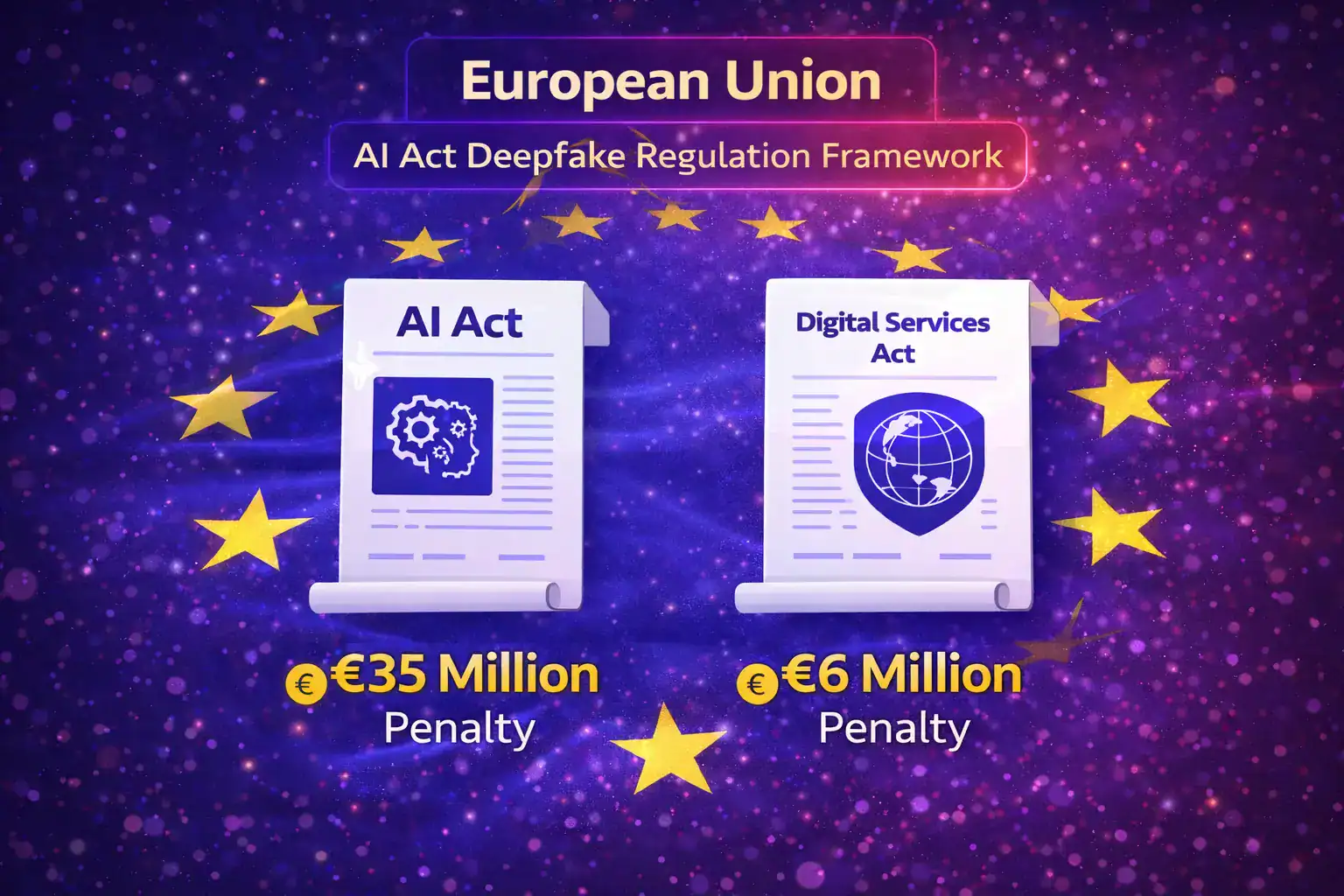
The EU addresses deepfakes through a combination of the AI Act, the Digital Services Act (DSA), and national laws.
AI Act
The EU AI Act, which entered full enforcement in phases starting in 2024, classifies deepfake-generating AI systems as “limited risk.” This requires:
- Transparency obligations: Users must be informed when content is AI-generated.
- Labeling requirements: AI-generated or manipulated content must be clearly marked.
- Technical documentation: Providers must maintain records of their systems’ capabilities and limitations.
The AI Act does not ban deepfake creation outright but establishes a framework of transparency requirements. Violations can result in fines of up to 15 million euros or 3% of global annual revenue.
Digital Services Act
The DSA requires platforms to address illegal content, including non-consensual intimate deepfakes, through notice-and-action mechanisms. Large platforms must implement systemic risk assessments that include evaluation of deepfake-related harms.
National Laws Within the EU
Germany: Sections 201a and 184 of the Criminal Code cover non-consensual intimate imagery, interpreted to include AI-generated content. Penalties: up to 2 years imprisonment. Deepfakes for fraud fall under separate provisions with higher penalties.
France: Updated Law No. 2024-449 specifically addresses AI-generated intimate imagery. Creation and distribution of non-consensual intimate deepfakes carries penalties of up to 2 years imprisonment and 60,000 euros in fines. When the victim is a minor, penalties increase to 5 years and 75,000 euros.
Spain: The Organic Law on Guarantee of Sexual Freedom (2022, amended 2024) covers AI-generated sexual content distributed without consent. Penalties range from 1 to 4 years imprisonment depending on severity and distribution scope.
Italy: Article 612-ter of the Penal Code, originally targeting revenge pornography, was amended in 2025 to explicitly include AI-generated content. Penalties: 1 to 6 years imprisonment.
Netherlands: Non-consensual intimate imagery legislation covers AI-generated content. Penalties: up to 2 years imprisonment for distribution.
United Kingdom
The UK has some of the most comprehensive deepfake laws in the world following the Online Safety Act 2023 and subsequent amendments.
- Creation of intimate deepfakes: Criminal offense even without distribution. Penalty: up to 2 years imprisonment.
- Distribution of intimate deepfakes: Criminal offense with enhanced penalties. Penalty: up to 2 years imprisonment (potentially more if combined with harassment charges).
- Threatening to create or distribute deepfakes: Criminal offense under harassment provisions.
- Platforms: Required to remove deepfake content promptly under the Online Safety Act or face enforcement action from Ofcom.
The UK approach is notable for criminalizing creation alone, not just distribution. A person who generates an intimate deepfake on their personal computer and never shares it has still committed an offense—a position not taken by most other jurisdictions.
Canada
Canada’s approach has been gradual. The Criminal Code amendment C-27 (under consideration as of early 2026) would specifically criminalize non-consensual intimate deepfakes. Current law relies on existing provisions:
- Criminal Code Section 162.1 — Publication of intimate images without consent. Courts have interpreted this to include AI-generated images in several 2024–2025 decisions, though the statute doesn’t explicitly mention AI.
- Provincial privacy legislation — Several provinces allow civil action for privacy violations including AI-generated intimate imagery.
Australia
Australia criminalized non-consensual sharing of intimate images (including AI-generated) under federal law in 2018, updated in 2024 to explicitly address synthetic media.
- Criminal penalties: Up to 6 years imprisonment for distribution of non-consensual intimate images.
- eSafety Commissioner: Has authority to issue civil penalty notices and removal orders for deepfake content. Can impose fines of up to AUD $555,000 for individuals and AUD $2.75 million for organizations.
- Online Safety Act 2021 (amended 2024): Requires platforms to have systems to detect and remove non-consensual intimate imagery, including deepfakes.
South Korea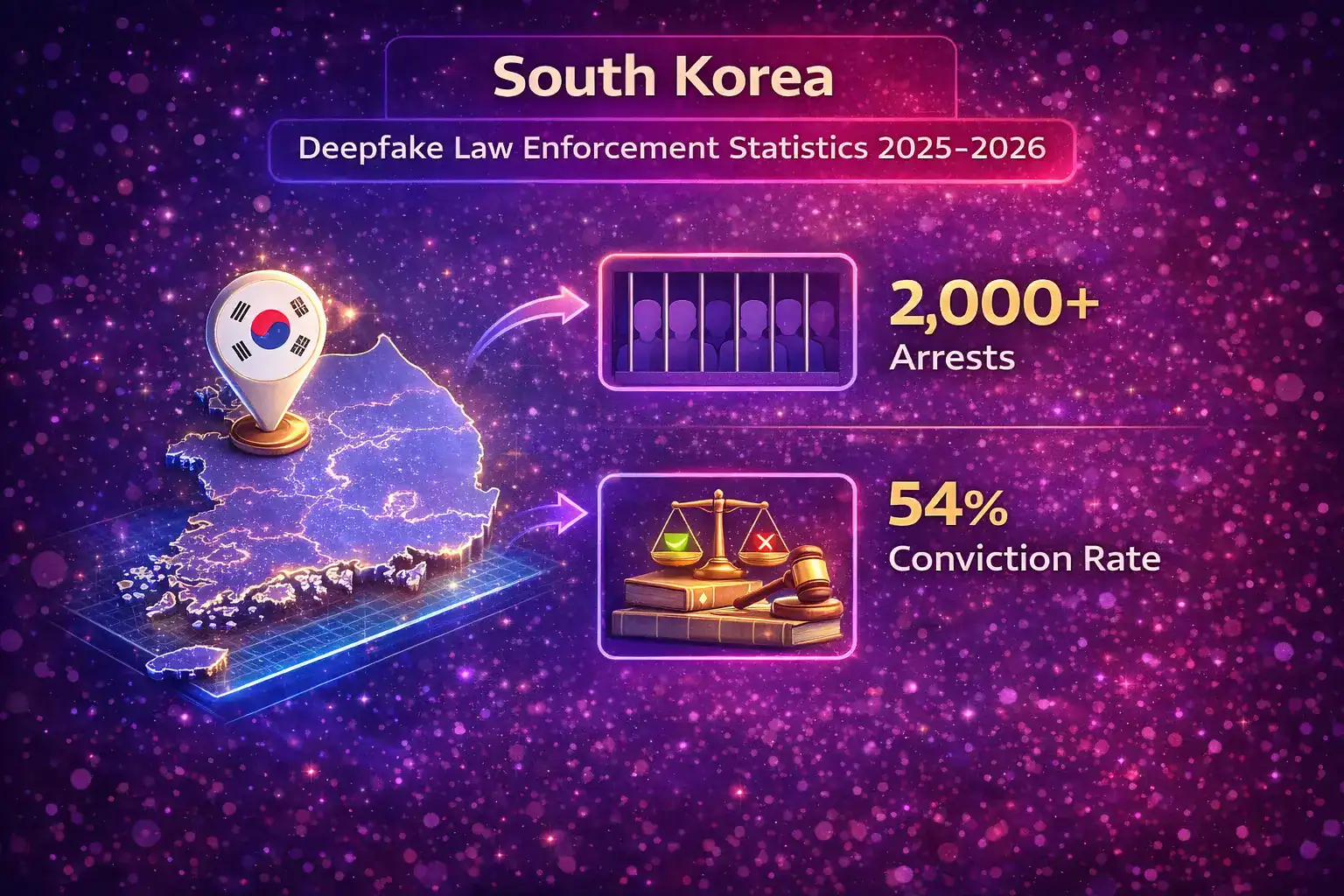
South Korea has responded to a deepfake crisis—a wave of non-consensual deepfake pornography targeting Korean women that became a national scandal in 2024—with aggressive legislation and enforcement.
- Sexual Violence Prevention Act (amended 2024): Criminalizes creation, distribution, and possession of non-consensual intimate deepfakes. Creation alone (without distribution) carries up to 5 years imprisonment.
- Enhanced penalties: Distribution carries up to 7 years imprisonment and fines up to 50 million won.
- Platform liability: Platforms that fail to remove deepfake content within 24 hours of notification face regulatory action.
- Enforcement: Over 800 arrests related to deepfake pornography were made in 2025, with the majority resulting in convictions.
South Korea’s enforcement intensity sets it apart from most other countries where laws exist but prosecutions are rare.
Japan
Japan’s response has been slower than South Korea’s despite facing similar issues. As of Q1 2026:
- No specific deepfake law exists at the national level.
- Existing laws on defamation (Criminal Code Article 230), insult (Article 231), and distribution of obscene materials (Article 175) may apply to deepfakes depending on circumstances.
- The Act on the Prevention of Non-Consensual Pornography Distribution (2014) has been applied to AI-generated content in limited cases, though its applicability remains legally uncertain.
- Legislative proposals for a dedicated deepfake law were introduced in the Diet in late 2025 and are expected to advance in 2026.
China
China implemented the Deep Synthesis Provisions in January 2023, making it one of the first countries with AI-specific content regulation.
- Requirement: All deep synthesis (deepfake) content must be labeled and traceable to its creator.
- Service providers: Must register with the Cyberspace Administration of China (CAC) and implement content moderation systems.
- Prohibited uses: Deepfakes that endanger national security, damage public interest, or infringe on others’ reputation, honor, or privacy.
- Penalties: Administrative penalties including fines and service suspension. Criminal prosecution possible under broader cybercrime laws.
China’s approach focuses on platform regulation and content labeling rather than individual criminal penalties. Enforcement has been active against platforms but less visible against individual creators.
Other Notable Jurisdictions
India: No specific deepfake law as of early 2026, despite government statements indicating intent to regulate. The Information Technology Act’s provisions on impersonation and obscenity offer partial coverage. The Digital India Act (draft) includes deepfake provisions but hasn’t been enacted.
Brazil: The Marco Civil da Internet and subsequent amendments address synthetic media in limited contexts. A dedicated deepfake bill was introduced in 2025 and is under committee review.
Singapore: The Protection from Online Falsehoods and Manipulation Act (POFMA) applies to deepfakes used for disinformation. The Online Criminal Harms Act provides additional tools for addressing non-consensual intimate imagery, including AI-generated content.
Israel: Updated sexual harassment and privacy laws in 2025 to explicitly cover AI-generated intimate imagery. Criminal penalties include up to 5 years imprisonment for distribution.
Enforcement Challenges
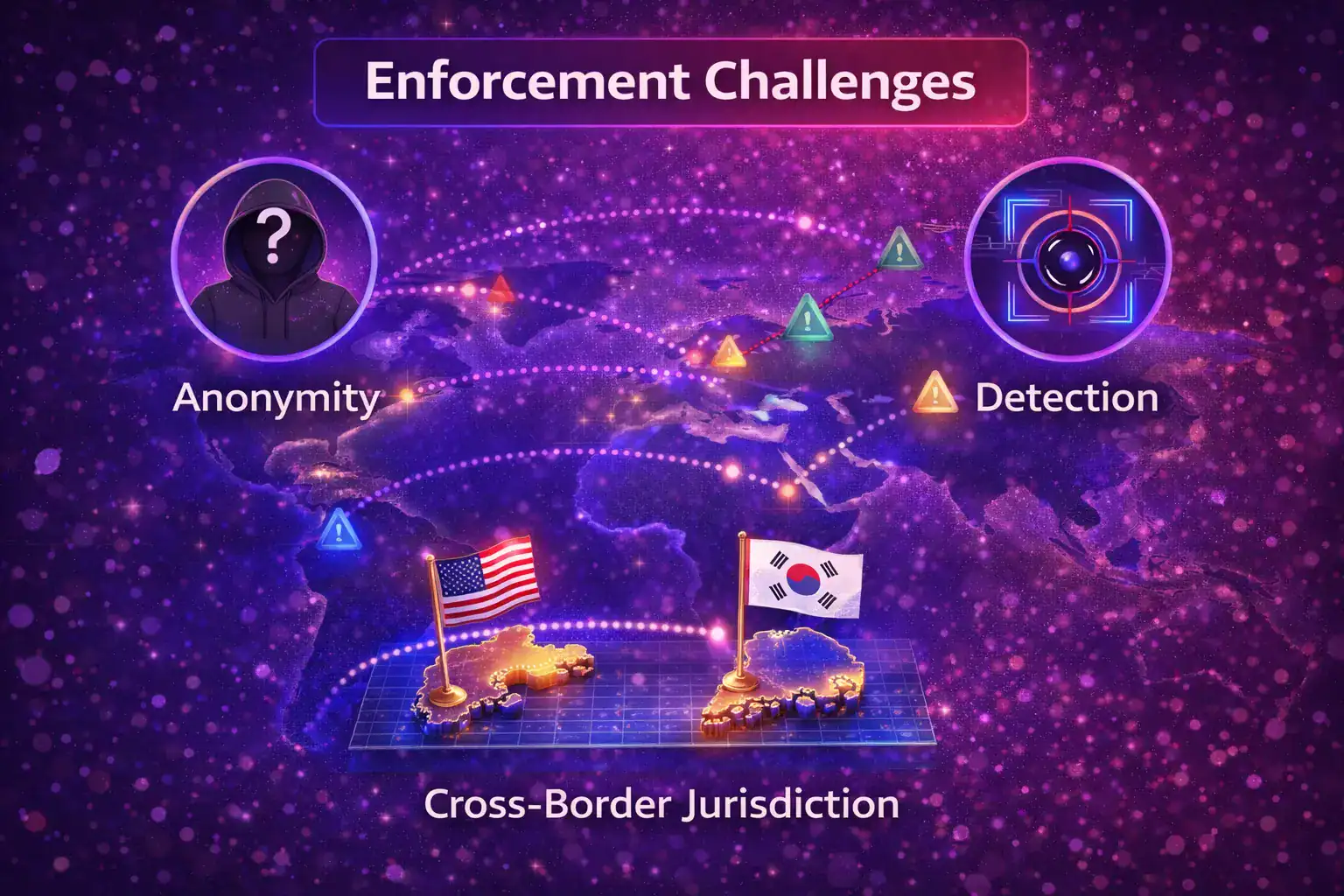
Even in jurisdictions with strong laws, enforcement faces persistent challenges.
Jurisdictional issues: A deepfake created in Country A using a platform hosted in Country B that depicts a person in Country C raises immediate questions about which jurisdiction’s laws apply. International cooperation on deepfake enforcement remains underdeveloped.
Anonymity: Most deepfake creation occurs on anonymous or pseudonymous platforms. Tracing content back to its creator requires cooperation from platforms, payment processors, and internet service providers—cooperation that isn’t always forthcoming, especially across borders.
Local generation: Content created on a personal computer using locally-run AI models leaves no trail on external platforms. Law enforcement typically becomes aware of locally-generated deepfakes only when they’re distributed, and by that point the creation evidence may be difficult to secure.
Volume: The sheer scale of deepfake creation overwhelms enforcement capacity. Millions of deepfake images and videos are created daily worldwide. Law enforcement can only pursue a tiny fraction of violations, typically focusing on cases involving minors, large-scale distribution, or celebrity victims.
Detection uncertainty: Proving that an image is AI-generated (rather than a real photograph) can be technically challenging in court. As generation quality improves, expert testimony about AI detection becomes less certain, which complicates prosecution.
What to Expect Next
The trajectory of deepfake regulation is clear: more laws, in more places, with increasing penalties. Specific developments likely in 2026–2027 include:
- Federal deepfake legislation in the United States, likely starting with non-consensual intimate imagery and election-related deepfakes.
- Enforcement actions under the EU AI Act’s transparency requirements, establishing precedent for how labeling obligations work in practice.
- International cooperation agreements specifically addressing cross-border deepfake enforcement.
- Mandatory AI content detection and labeling requirements for major social media and content platforms.
- Expansion of victim support services and streamlined takedown procedures modeled on Australia’s eSafety Commissioner approach.
For individuals and organizations working with AI-generated content, the practical advice is simple: assume that non-consensual intimate deepfakes are or will soon be illegal in your jurisdiction, label AI-generated content as such, and maintain records that demonstrate compliance with applicable regulations. The legal environment is moving in one direction, and platforms or individuals who don’t adapt will face increasing legal risk.